Political Evolution: From the 70s to the early 00s
The 1970’s was marked by social and political upheaval across the globe. Anti- war movements were prominent in countries around the world, as well as environmentalism, civil rights activism, and economic hardship. This page will explore some of the political movements and events throughout the decades that were important in the punk subculture.

Anti-Nazi League (est. 1978) and Rock Against Racism (est. 1976)
The ANL was founded in 1977 in response to the rise of the National Front, a far-right, fascist political program in the UK. The ANL organized a series of counter demonstrations to the far-right party, in hopes of breaking through the 1979 general election. Rock Against Racism was a movement that emerged in 1976 as a reaction to the violent racist attacks on the streets in the UK, using concerts and music as a form of protest.
In April and July of 1978, ANL and Rock Against Racism came together and organized two national carnivals in protest of the racist attacks. The Northern carnival, which took place in July, consisted of 40,000 people who marched in protest of the National front and racist attacks. In April, 100,000 people marched from Londons Trafalgar Square to East London, where an open aired concert was played featuring punk bands like The Clash, X-Ray Spec and Steel Pulse.
Anti-Nazi League poster promoting the Rock Against Racism festival 1978
 |
Anti-Nazi League protesters during a demonstration against the National Front Rock Against Reagan (1983-1984)Rock Against Reagan was a rock tour organized by the Youth International Party, a radical and counterculture organization which often advocated for free speech and against war. The group was famous for their protests and theatrical pranks used to mock the status quo, at one point nominating a pig for president: "Pigasus The Immortal". Ronald Reagan was infamous in the punk scene for his far right ideologies and his economic policies which cut taxes for the wealthy, ultimately leading to youth and punk outrage. |
The Rock Against Reagan tour was a protest of Ronald Reagans run for a second term. By touring across the country, offering free music featuring some of the most famous punk bands at the time such as The Dead Kennedys, MDC, The Dicks and more, they were able to attract a large crowd to promote and share their cause. Not only did the RAR tour offer free music, it also registered voters, presented informative films and speakers, and included comedy acts with figures such as Whoopi Goldberg.
 |
Rock Against Reagan Ad, 1983Police BrutalityThe 80s saw a new genre of punk: Hardcore. The hardcore punk scene was an underground movement originating in Los Angeles and San Francisco. With the underground hardcore punk scene, came police brutality. This was seen as an attempt by an established authority to oppress and disrupt a group of people they saw as a threat. Most famously, Black Flag, a growing punk band in LA, would frequently experience police brutality at their shows. Shows would be raided, people arrested and beaten, which led to brawls and riots between both sides. Punk bands would often use their musical platform to speak out against police brutality. Below I added a clip that showcases the treatment the punk scene received by the police, including an interview in 1980 with a member of Black Flag, who speaks about the violence. Riot GrrrlRiot Grrrl was a feminist movement that started in the underground scene of Washington in the early 90s. The movement addressed sexism and women empowerment while encouraging women to use their voice by making their own music and fanzines. The movement was a way for women to act against the status quo by rebelling against what society expected of them while emphasizing femininity. The punk scene had always been male dominated, and women were not looked at as a legitimate part of the community, until the Riot Grrrl movement started using punk music as a tool to spread their message. Bands like Bikini Kill, Bratmobile, and L7 left lasting impacts on the feminist movement. The Riot Grrrl movement incorporated DIY ethics by making their own magazines which would often provide resources for women who struggled with mental illness or sexual abuse. 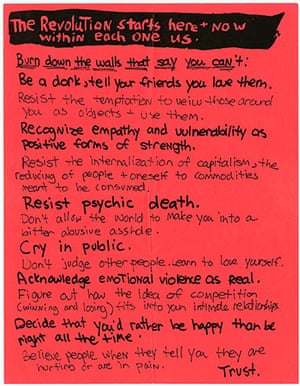 Flyer by Kathleen Hanna of Bikini Kill Democratic National Convention Protest, 2000The protests surrounding the Democratic National Convention occurred in Los Angeles from August 14-17, 2000. There were multiple demonstrations involving thousands of individuals who protested for different causes including a protest in support of Mumia Abu-Jamal, an inmate on death row, labor groups in protest, environmentalists, and more. Although these movements were peaceful, the streets were covered with police in riot gear with tactical equipment who expected violence. On August 14th, Rage Against the Machine played a free concert outside of the convention center in protest along with thousands of other people. Zack de la Rocha, lead singer expressed his anger to the crowd: "Brothers and sisters, our democracy has been hijacked... We have the right to oppose these motherfuckers!" The concert drew in almost 50,000 people, making it the biggest protest of the DNC. However, after the concert, the police declared the gathering an unlawful assembly. The protest ended in a violent riot between demonstrators and police. Although police opened fire with pepper spray and threatened to arrest those who didn't leave, some held their ground, calling for an end to corporate welfare, and some waving black flags that symbolize anarchy.Rage Against the Machine, 2000 Democratic National Convention |


Comments
Post a Comment